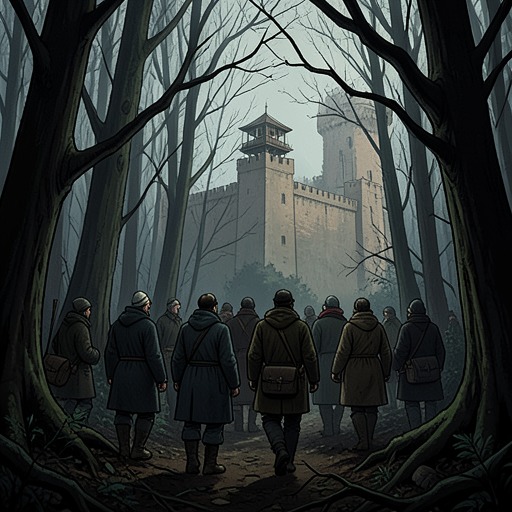
Walls put borders on the darkness
Chasing Sunlight“Walls put borders on the darkness” is a statement by Antomine that condenses the human ideology of survival in a lightless world. Spoken while he defends the Illuminated King’s order against Ukari, it presents civilization not as the elimination of darkness but as the construction of boundaries that make darkness manageable. The phrase is therefore both a practical description of human settlement and a declaration of moral identity: humanity claims to remain human by resisting the dark rather than becoming its master through imitation.
Origin and Immediate Meaning
The expression occurs in Antomine’s argument with Ukari, who has dismissed human safety behind walls as an imagined refuge that produces weakness and decadence. Antomine answers by touching the inquisitor’s symbol around his neck and insisting that humanity does not bend to the dark; instead, humanity bends darkness to human terms. In this context, walls are not merely architectural barriers. They represent the coordinated institutions, beliefs, and restraints through which human beings define a habitable sphere inside an otherwise hostile world.
Antomine’s wording also distinguishes human victory from conquest in Ukari’s sense. He rejects the ambition to seek out darkness on its own terms and become its king or queen. His preferred model is inward mastery: humanity must master itself, impose limits on the surrounding world, and become a light against the dark. The phrase thus gives spatial form to a spiritual argument. A wall marks where human conduct, human law, and human identity are supposed to begin and end.
Walls as Civilizational Infrastructure
The wider setting gives the expression a literal foundation. Human civilization depends on illuminated routes and defended settlements beneath lightless skies, while the Illuminated King and the Inquisition attempt to preserve a human sphere against forces that cannot be fully understood or controlled. At Danby’s Point, the easternmost terminus of the illuminated track stands at the base of a zint-illuminated tower built into bruised-purple rock. Human light spreads across one side of a plateau, meeting the lights and architecture of other races at a frontier where trade is tolerated but contact is deliberately contained.
The boundary at Danby’s Point makes Antomine’s metaphor visible. A great metal gate, lit by intense zint light, separates the human portion of the plateau from territory claimed by darker forces. Yet the boundary is not impermeable: the further spires become more twisted, while structures near the wall are drawn into straighter lines, suggesting that influence travels in both directions. The wall appears to border darkness, but it also reveals that human and nonhuman spaces are already affecting one another.
This frontier complicates any simple image of protective separation. Danby’s Point is simultaneously the Inquisition’s strongest and weakest point. Human authorities attempt to regulate contact and restrain the growth of alien influence, but the very existence of the gate acknowledges dependence on exchange. Jonathan Heights must walk through the boundary, inspect and sign enormous quantities of cargo for the Endeavor, and rely on information acquired beyond the human zone. The wall therefore enables civilization while also exposing its need for what lies outside it.
Containment, Knowledge, and Power
The expression is inseparable from the human practice of classifying and containing the unknown. Beyond the gate, the Fractured appear as unstable mockeries of human bodies, with changing faces, shifting limbs, and hands whose number of fingers can alter within seconds. Other beings are many-limbed black-tar forms with human eyes, ranging from the size of Penelope to creatures larger than any building can contain. These descriptions establish the darkness not simply as a place but as a category applied to bodies, architectures, and forms of life that resist human standards of shape and order.
Jonathan’s dealings at Danby’s Point show that the wall does not stop knowledge from crossing the border; it organizes the terms under which knowledge is acquired. Tiuni provides intelligence about movements among the Thrantin, the changing growth of the Verdant Expanse, and ancient ruins in the eastern lands. Jonathan records the information on maps, narrows possible routes, and treats Tiuni as his final source before ventures beyond human territory. The frontier is thus maintained through maps, trade, translation, and selective reliance as much as through metal and light.
The phrase also carries a practical logic in the dispute over Angkor Leng. Antomine argues that a nest of Umbraught must be purged because the creatures now know that zint exists and might hunt it westward, causing unknown damage. Jonathan refuses to divert the Endeavor, pointing out that the expedition is not a navy and lacks the time or resources to survey and cleanse a city the size of Angkor Leng. Antomine’s position treats civilization as an ongoing duty to extend protection beyond immediate convenience; Jonathan’s resistance exposes the material limits hidden inside that ideal.
Ideological and Colonial Implications
Antomine’s formulation makes the human order sound defensive, but the surrounding scenes reveal that defense and expansion are difficult to separate. Human authorities define their own illuminated constructions as civilization while describing eastern territories, alien buildings, and nonhuman inhabitants through the language of savagery, aberrance, and danger. At Danby’s Point, human architecture is portrayed as straight and proud, whereas alien spires are twisted and repugnant to human sensibilities. The wall consequently becomes a device for turning aesthetic judgment into political geography.
The expression also supports a system in which contact is permitted only under human control. Trade must be inevitable but contained; alien influence must be watched; zint must be protected from dissemination; and information from beyond the frontier must be converted into routes that serve an expedition’s objectives. The same border that promises safety helps establish who may move, who may trade, whose knowledge counts, and which territory is treated as a threat requiring purification. In that sense, “Walls put borders on the darkness” is not only a survival maxim. It is also a concise expression of the ideology by which human civilization legitimizes surveillance, restriction, and intervention.
Narrative Significance
The phrase crystallizes the central conflict between Antomine’s duty-bound civilizational faith and the wider world’s refusal to remain outside human boundaries. Antomine believes walls allow people to walk freely and without worry, yet Danby’s Point shows that the border is unstable, influence is reciprocal, and the beings beyond it cannot be reduced to a single enemy. Ukari’s challenge identifies the psychological danger of enclosed security, while Antomine’s reply insists that abandoning restraint would mean abandoning humanity itself.
Its power comes from this unresolved tension. The wall is protection, doctrine, infrastructure, and exclusion at once. It gives human beings a form of freedom, but only by defining darkness as something to be bounded and managed. It permits trade while policing contact, produces knowledge while ranking the people from whom that knowledge comes, and promises moral order while authorizing force against whatever threatens the boundary. Antomine’s sentence therefore functions as a motto for the human world and as an implicit question about whether a civilization can draw borders around darkness without reproducing the violence it claims to contain.